

Science Communication and Social Media Work
Science Communication and Social Media Work as Part of the OntoTrans Project
Or – Who are our OntoTrans fans?
By Alexandra Simperler, Laura Waslmayr, Xiran Dong, Vikki Cantrill, Ernst-Dieter Janotka, Gerhard Goldbeck, and Nadja Adamovic
Acknowledgements
This study has received funding from the European Union’s Horizon 2020 research and innovation programme under Grant Agreement No 862136 (OntoTrans Project). The authors thank all the survey participants for taking the time to respond to our questions.
A version of record of this work is available here.
The Move to Open Translations Environments
Sending a Clear Message
Our Online Look
Who are You?
Our Visibility
OntoTrans LinkedIn Analytics
MatCHMaker LinkedIn Analytics
EMMC LinkedIn Analytics
What we Asked
Our Survey Said…!
LinkedIn Community
Who Tweets?
Instagram picks
Conclusion
Survey link
The Move to Open Translations Environments
Research and development (R&D) in materials and manufacturing industries are facing the need to integrate data and discover complex knowledge from ever more diverse sources. Data are stored in often disparate, non-standardised repositories and score poorly in terms of their FAIR attributes. Furthermore, over the last few decades, advances in materials modelling have evolved to the extent that models provide a further source of data in industrial R&D. Providing easier access to all of these data sources to a broader spectrum of R&D scientists and engineers is a key differentiator for successful innovation built on faster and better-informed decision-making.
These changes have fuelled the need for a digital transition, to bring together data and knowledge into an interoperable system, to discover new knowledge and answer complex queries. Globally, such digital transitions help address green and sustainability concerns. Individual businesses benefit from improvements in efficiency and accessibility to enable faster decision-making, which reduces costs, enhances customer experience, and ensures a business can remain competitive.
OntoTrans is an EU-funded project that works to provide an ontology-based open translation environment in materials modelling and manufacturing. The project includes people from universities, research and development organisations, consultants, software developers, and materials manufacturing companies.
The diverse nature of the project means that many scientists and business experts may be interested in the work that we do, so getting the message out about the results and benefits of our work to a broad audience is essential.
Sending a Clear Message
Over recent years, science communication has become arguably a more important and integral part of a project’s success with the need to provide information about project results and outreach activities to specialists and the general public alike. Scientists often attend conferences and training sessions, and get involved with science projects, but they often feel less equipped and able to communicate with the general public.
The internet has made communication between scientists and the public easier and faster than ever before, so effective science communication is essential to share and promote accurate information and encourage engagement. This is particularly important because online, specialist and public professional communications are not separate. Furthermore, the importance of illustrations/visual content in science dissemination work cannot be overstated; content needs to be both engaging and accessible, so effective use of social media platforms is key.
Indeed, effective science communication is a general obligation for all recipients of EU funding to ensure EU visibility. A comprehensive strategy and plan for communication and dissemination activities is called for at the beginning of all projects, which serves as a basis for evaluations during the project’s life cycle. Despite the emphasis on public communication, it is not always possible to understand the reach of these efforts and so any insights, for example from surveys, can serve to inform and improve approaches to project result dissemination.
During our project, we have looked to maximise our science communication and dissemination activities, and we are keen to understand who we were reaching with our efforts and get know a little more about what was learned and why it was of interest. In fact, if you are reading this article, this means you!
Our Online Look
From the outset, OntoTrans had a dedicated look and feel for all forms of communication to ensure consistent branding throughout the project by all partners. Our colour scheme comes in rose and turquoise and it displays the project name in a circle. A third-party graphics designer was commissioned with this task and supplied with a project description.

These logos and the colour scheme create a project identity and to promote public identification and recognition of our work. OntoTrans is a portmanteau of ontology and translation. The colouring and different fonts gives “Onto” and “Trans” their individuality and the circle combines them as we do in our project.
For LinkedIn, we used the rose colour scheme, and displayed the logo and a banner:

The same colour scheme was used for Twitter/X:
We kept our Instagram header sleek:

However, we created turquoise and rose posts, except for the first pinned post that is grey. The first post differs because it introduces the reader to what our project is and does. Thes going forward, rose-coloured content has been associated with introductory/less-difficult content and turquoise posts have been used to deliver more involved topics. We chose to post with the colours alternating to achieve a mosaic effect of the turquoise and rose tiles because Instagram shows an overview of three posts in a row. The graphics were selected from Canva and we aligned the colour scheme with their editing tools.

Who are You?
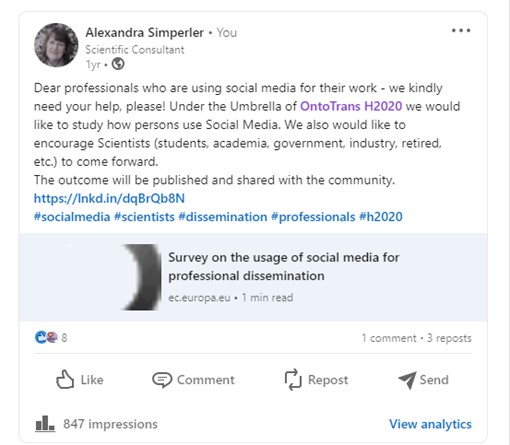
To shed light on the perception of our science communication activities, we conducted an online survey that targeted social media users who would most likely be interested in the OntoTrans project. To do so, we reached out to people interested in the H2020 project OntoTrans, associated Horizon Europe project MatCHMaker, and people involved with the European Materials Modelling Council (EMMC), who kindly assisted by promoting our survey.
To understand our audience, we analysed how people consumed our content on the social media platforms that we use to disseminate OntoTrans project results – LinkedIn, Twitter/X and Instagram – based on your survey responses in 2022.
Briefly, survey responses spanned all age groups, which implies the project is known to young researchers, scientists, entrepreneurs and experienced professionals and most were from Europe (84%). Respondents were, on the whole, affiliated with universities (50%), but with research centres (16%) and industry (10%) also represented and primarily from the engineering and physics sector. The job roles that people held were also spread from the most junior to the most senior. We also aim to reach the general public and raise awareness of our work, however, on this occasion, the general invite was open but promoted by means of LinkedIn.
Our Visibility
To get a little bit of insight into who reads the content that we publish, we looked at our recent analytics numbers on LinkedIn. LinkedIn analytical data was used in this instance because we are able to gain information about the location and background of the people who view our content unlike analytical data from Twitter/X and Instagram.
OntoTrans LinkedIn Analytics
Between November 2022 and November 2023, the OntoTrans project LinkedIn page had 363 page views by 163 unique visitors from within Europe.
People visiting the OntoTrans LinkedIn page were from research services (40.2%), software development (15.4%) and IT services and IT consulting (8.3%). A good number of these visitors had careers associated with media and communication (26.4%) or research (15.4%), with a fairly even split between junior (39.9%) and senior/manager (35.8%) staff.
MatCHMaker LinkedIn Analytics
The MatCHMaker project opened its account in March 2023. To November 2023, its LinkedIn page received 652 page views and 262 unique visitors mostly from Europe. Visitors typically worked in research services (40.2%), other industries include business consulting and services (9.4%), non-governmental organisations (8.9%) and industrial machinery manufacturing (6.1%).
Visitors’ careers included media and communication (19.2%), research (16%), engineering (14%) and information technology (8.3%) alongside other sectors, such as education and business development.
Interestingly, a larger proportion of visitors were junior staff (46.6%) relative to senior staff (27.6%), directors (9.7%).
EMMC LinkedIn Analytics
From November 2022–November 2023, EMMC had 797 page views and 354 unique visitors, with almost all visitors being based in Europe. The spread of industries and job functions were similar to those seen for OntoTrans and MatCHMaker.
In contrast to the two projects above, the EMMC attracts slightly more senior-level visitors (41%) than junior ones (31.1%), which perhaps reflects the EMMC membership demographic.
What we Asked
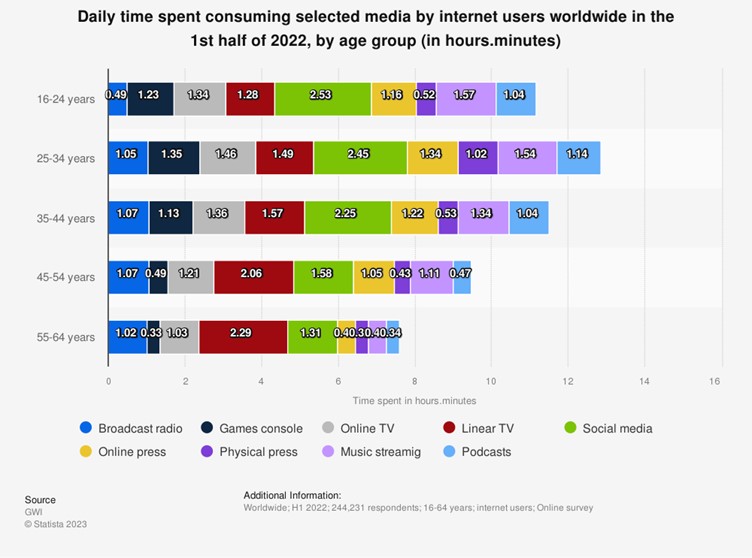
According to Statista, the daily time spent on social media across all ages groups is significant relative to time spent consuming other forms of media.
So, we asked questions about three social media platforms:
- LinkedIn – a primarily professional environment
- X (then known as Twitter) – a short-form post site used for personal and professional updates and news
- Instagram – used both personally and professionally with an emphasis on visual and multimedia content
As of January 2023, the majority (61%) of Instagram users are aged between 18–34. The challenge here is to make content creative, engaging and informative for the primary users to help aid dissemination to reach the general public.
The EUSurvey service supported by the European Commission’s DEP-Interoperability programme was used. The survey was promoted through the EMMC, OntoTrans and the personal social media accounts of some of the project participants. In total, 84 complete responses were received and evaluated.
Questions about geographical location, age, sector and career stage alongside questions on social media usage were posed. We asked about online identity, purpose, frequency, behaviour (type of engagement) and preferences about the three platforms selected for study.
Our Survey Said…!
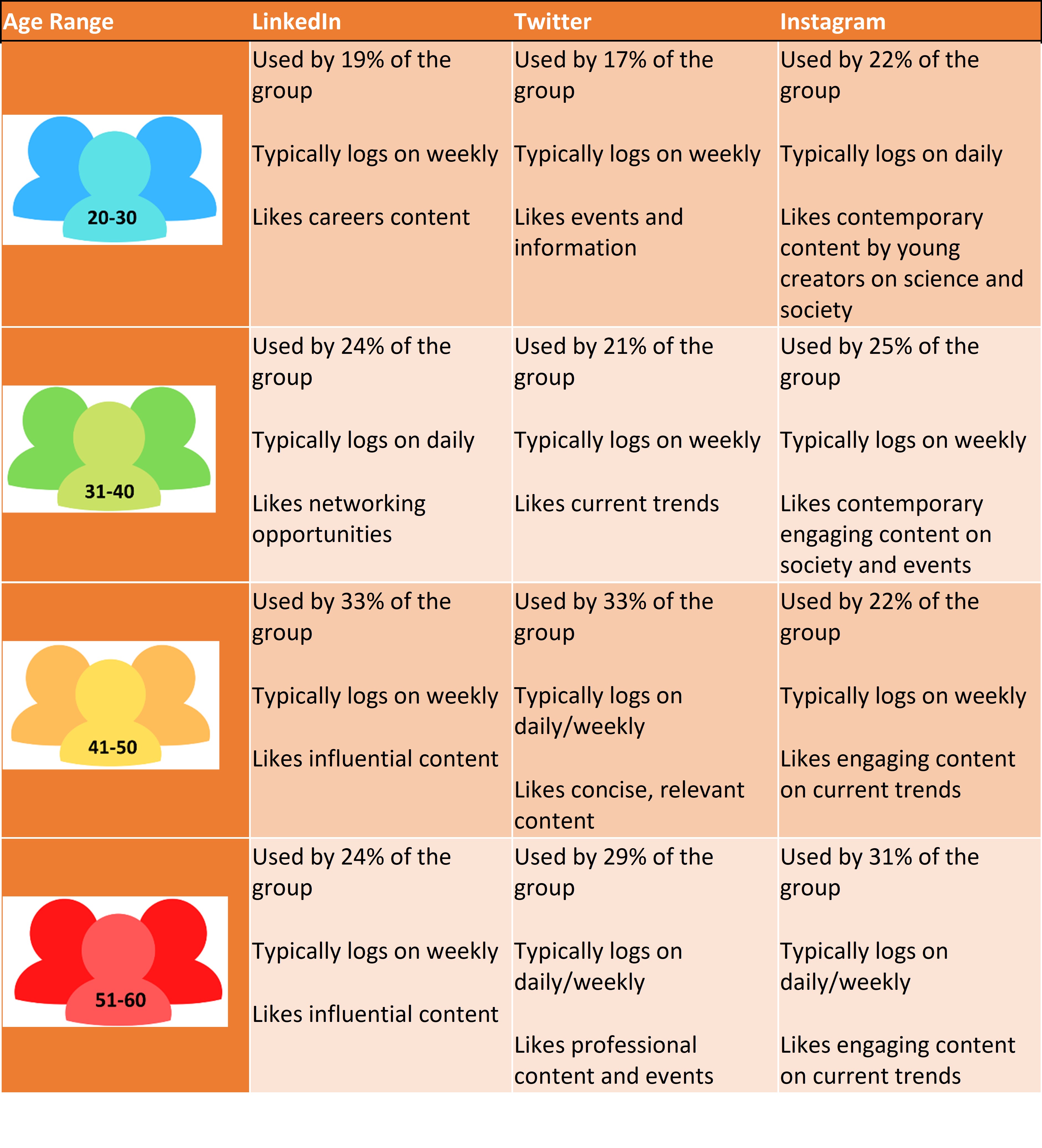
For science communication to be effective, you need to know your audience, and our projects are no different. When we consider audiences for our social media work, we broadly make the following assumptions. Our audience aged 20–30 years attends university, does research, and is in the early stages of their career, so we want to let them know about OntoTrans and the technology behind it, and raise awareness of careers in this sector. Those aged 31–40 are likely established in their careers and develop new knowledge through continued professional development or independent learning, so papers, articles, and training materials are useful to this group and social media helps to steer them towards suitable materials.
For the 41–50-year-old audience, who may already occupy senior roles, we aim to provide more strategic information about the OntoTrans project and its related technology, ontologies and semantic data analyses to add to their portfolio of ideas. And for anyone aged 51 or above, we aim to raise awareness and keep them up to date with our project. Feedback and engagement with our project are welcomed. We want to present our ideas and are keen to hear comments and advice. A summary of the results is in the table below.
LinkedIn Community
FFrom our survey we discovered that respondents were interested in and active on LinkedIn. People primarily log on in a professional capacity, as expected, either daily or weekly. Younger respondents were typically more interested in careers and networking opportunities, whereas older people wanted news and information about leaders in their respective areas of interest. The older a respondent was, the more likely they were to actively post and comment, or post on behalf of an organisation.
Who Tweets?
Similar patterns of use were seen when respondents were asked about their use of Twitter/X as for LinkedIn. Older respondents were more likely to actively engage by commenting, reposting or posting on behalf of an organisation. A concise, entertaining yet professional style for content was preferred with the oldest and youngest users mentioning their interest in reading about events.
Instagram picks
The primarily video- and photo-focussed platform, Instagram, is well known to be popular with younger users. Interestingly, our survey respondents of all ages used Instagram regularly, with the oldest age group being the most represented. Instagram, the fourth largest social media platform, is typically used more in a private capacity. Here, older users are known to log in from time to time to keep up to date with the lives and events of friends and family. All users preferred informal and entertaining content with the oldest and youngest users the most likely to share and comment.
The allure of Instagram attracts younger users with many opting to view posts more than once a day. They will search for content that they find interesting, both personally and professionally, and readily share these with their friends.
Other age groups typically interact on Instagram on a weekly basis and engage with content of particular interest both personal and professional. Overall, the expectation of users is that this informal platform should be enjoyable and entertaining to use.
Conclusion
Science communication has long been a key component of research studies, but the immediacy of social media platforms enables quick and easy access to the most up-to-date information. Science communicators are bridging the gap between scientists and the general public with these contemporary tools.
As expected, our findings confirm that the different platforms need to be treated slightly differently when planning and publishing content. LinkedIn, as a networking tool, requires posts with a professional focus. Twitter/X posts benefit from concise and precise messages to encourage engagement. And Instagram, with the youngest audience globally, values informal content.
We are grateful to all survey participants. Their responses and insights have informed and helped us to further develop our effective communication and dissemination strategy; the insights from which project partners can take forward into future projects.
The results also enable us to explore new ways to educate and entertain a global audience to make science and technology ever more accessible and inclusive. Here, Instagram is an unconventional channel for communicating EU research project activities yet has the potential to reach a broader and younger audience than through other social media platforms with its more relaxed format.
Disclaimer
All information contained in this study and any opinions expressed in it are intended to share the insights the authors have gained on a survey on social media usage during their work on the H2020 Project OntoTrans. All statements of fact, opinion, or analysis expressed in the report are those of the authors. The information used and statements of fact made are not guarantees, warranties or representations as to their completeness or accuracy. The authors assume no liability for any short- or long-term professional decisions made by any reader based on analysis included in this report.


Leave a Reply
Want to join the discussion?Feel free to contribute!